


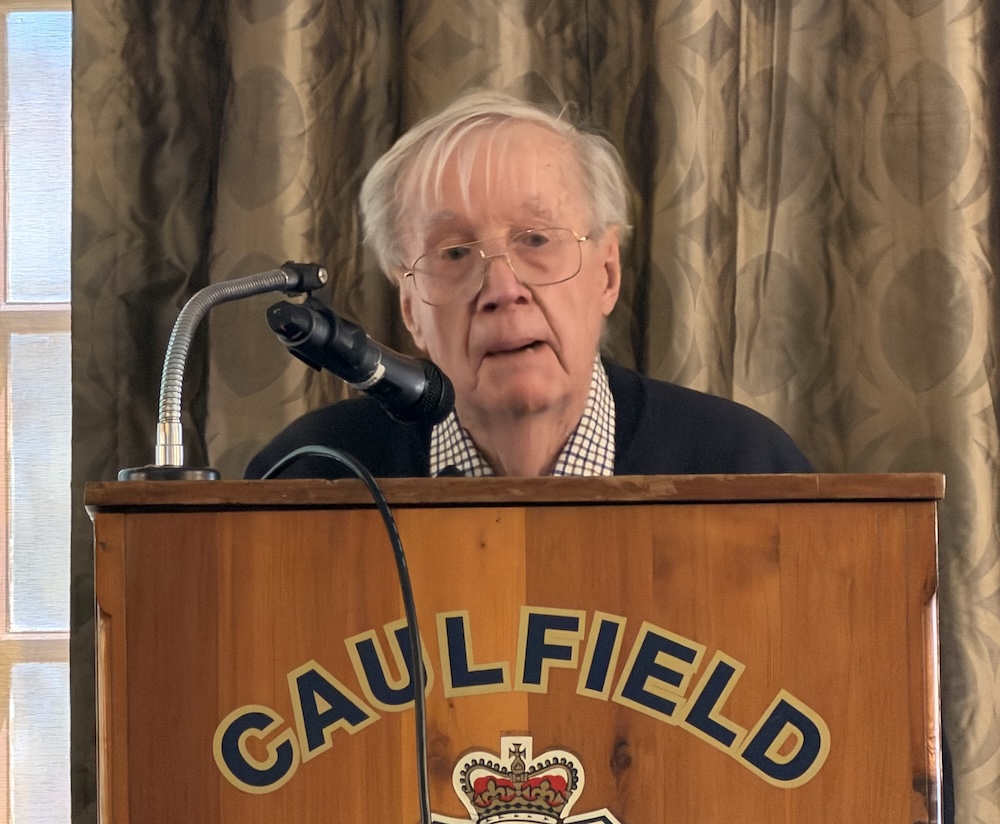
Just under 50 attended the Melbourne Lunch and AGM held at the Caulfield RSL. The club’s Annual General Meeting was held first, with some members joining via video conferencing.

The record crowd were obviously keen to hear today’s guest speaker.

Peter Cossins VK3BFG, spoke about the “Melbourne ATV Repeater VK3RTV A Brief History – the journey from Analogue AM to High Definition Television”.
A city hooked on television
Several things made Melbourne fertile ground for amateur television. Ian McKenzie’s simple converter could be built from a scrap of printed circuit board, some rod and a few trimmers, and nearly everyone made one. Les Jenkins added a compact FET local oscillator that was little more than a transistor and a piece of wire. A Vic Division WIA television display fired Peter’s own interest, the British Amateur TV Club magazine supplied project ideas, and kits circulated among clubs.
By the 1970s Melbourne had around a hundred ATV stations. Today it has about 26, which Peter suspects is still more than any other city in the world, though he admits he can’t prove it.
Olinda and the Education Department
VK3RTV was first licensed in 1977. The original plan was a shack near the big commercial television transmitters, an idea Peter doubts would ever have worked. The site that did was a tower at Olinda, thanks to Brian Baker 3HB, a technical officer with the Victorian Education Department. The department had built the tower as a radio hub for patrol cars guarding school property against vandalism, and it contributed cabling and other resources over the years.
Les Jenkins built the first version of the repeater. It transmitted on 50 cm and received on 70 cm, using eight three-element Yagis matched by a small T network that Peter still keeps. The arrays lasted about ten years before they lost performance. The department later acquired a 10-watt Hirschmann translator. The team removed its internal loop, added a homebrew detector and a DJ4IF modulator, and gave the sound its own 1-watt amplifier. When the 50 cm allocation was lost, the repeater moved to 70 cm. Later it took inputs on 23 cm FM using satellite receivers, with one antenna looking west and another down the south-east corridor.
A world first, then disaster
The biggest change was the move to digital. Peter says the two-channel standard-definition system, funded by Amateur Radio Victoria and the WIA, was the first of its kind in Australia and well ahead of the Americans. Only small groups in England and Germany were doing anything similar. Most of the controller boards were made in his garage. A 500-watt amplifier built from a W6PQL kit followed, run at only 100 watts so that intermodulation stays low. He describes it as being “as tame as you could ever imagine”, despite his nerves at first switch-on.
Then came the Olinda tower’s neighbour, a primary school. Parents worried that children were being irradiated. Peter says he explained that the RF level at the base of the tower was well below that of their mobile phones, but the tower came down anyway, and the repeater was off air for about five years.
The next home was a dormant Telstra site at Canterbury, still full of old Channel 2, 7 and 9 television gear, and Peter was told he could take whatever he wanted. The repeater ran for about half a day before it began interfering with the Motorola network used by the police, fire brigade and other government services. Radio inspectors were on site within hours, and Amateur Radio Victoria received a mild reprimand. The output filter had been too basic for a site like that. An Italian company retuned one of its commercial DVB-T filters for about $1,000, and that filter is still in service.
Mountview and high definition
Today VK3RTV is at Mountview, beside a Melbourne Water reservoir near the police academy. A commercial vertical antenna handles transmission, and four home-built dual-quad panels give 18 to 25 dB of return loss across the band. Peter says he threw away a stack of failed quads before getting them right.
The transmit chain uses two H.264 encoders feeding a multiplexer and modulator. Three linear amplifiers follow, each run well below its rating, ending in the 500-watt unit at 100 watts with protection against VSWR, temperature and voltage faults.
The controller is built around a PICAXE microcontroller, “designed for primary school students”, as Peter puts it, and “about my level for programming”. It switches the HDMI inputs, strips the audio to add the station ID and a selectable 0 VU tone, and responds to DTMF commands. The most popular command returns a signal report on quantity and quality. The receivers are repurposed set-top boxes with dual tuners, one taking DVB-S and DVB-S2 directly and the other taking 23 cm DVB-T down-converted to a domestic channel. They poll between the two inputs, so all the switching happens inside the receivers. Everything is duplicated for the two channels.
Not everything has gone smoothly. When the DVB-T filter was swept after a year or two, it had degraded, probably from moisture already inside it when it was delivered. Two weeks in a vinegar soak revived it, and it now has 2 dB of insertion loss compared with 1 dB originally.
Linked to the world
With fibre to the shack, VK3RTV uses SRT, a protocol for sending wideband video over the internet, to link with VK5RDC in South Australia. Peter would like to add Bendigo, Geelong (if a repeater appears there) and Tasmania. Each year he also hosts a DATV QSO party as the local anchor, linking with operators in Columbus, Boulder, Southern California and the UK. Signals travel by SRT and the QO-100 satellite, so pictures also arrive from France, Holland, Germany and possibly South Africa. He admits he is glad when the day is over, but says the event is well supported.
What’s next
Peter is considering 10 GHz FM, which would suit owners of the Icom IC-905, and narrowband TV on 6 m or 2 m. He has already made one contact on his six-metre transverter, to a station near Mount Dandenong, though he never received a QSL card. Six metres already has a wideband allocation starting at 52.5 MHz, and a few people are experimenting on 10 metres.
He is also trying to document the system, because it has grown by accretion, one suggestion at a time, and he isn’t sure anyone else could work out how it all fits together. In his view that constant change is simply what amateur experimenting looks like.
 Chris James
 Tim